
Summary
Maximizing a small bedroom office requires a strategic approach to furniture placement that balances professional productivity with the comfort of a sleeping sanctuary. By utilizing L-shaped desks to exploit underused corners and create functional zones, you can establish a high-performance workstation that maintains a compact footprint without compromising on ergonomic standards or room aesthetics.
Key takeaways
- Corner Optimization: L-shaped desks turn dead corner space into active work zones, providing nearly double the surface area of standard rectangular desks in the same footprint.
- Psychological Zoning: Positioning the desk to face away from the bed or using it as a room divider helps maintain a mental boundary between work and rest.
- Ergonomic Stability: Proper weight distribution and the use of monitor mounts are critical for maintaining stability on the extended arms of compact desks.
- Integrated Storage: Choosing models with built-in shelving or cabinets reduces the need for additional furniture, keeping the floor area clear and the room feeling larger.
- Lighting & Power: Strategic placement near outlets and the use of specialized corner lighting are essential to avoid shadows and cable clutter in small bedroom setups.

How to Choose the Best L-Shaped Desk for Small Bedroom Offices
Selecting the right furniture is the foundation of a successful small-space layout. When space is at a premium, every inch must be accounted for. For those in compact urban dwellings, a 42-inch L-shaped desk with storage cabinet often provides the ideal balance between a usable work surface and a minimal footprint. These compact models are designed to tuck into tight corners while offering integrated shelving that replaces the need for separate bookcases or filing cabinets.
Beyond dimensions, consider the visual weight of the desk. In a small bedroom, a desk with an open frame or glass elements can prevent the room from feeling cramped. Utilizing space-enhancing techniques for small rooms involves choosing furniture that allows light to pass through and floor space to remain visible. This transparency creates an illusion of openness, which is vital when your office and bedroom share the same four walls.
Logic Summary: This recommendation assumes a standard bedroom size of 100-120 square feet. In smaller "micro-apartments," even a 42-inch desk may require removing a nightstand. The focus is on vertical storage to minimize the horizontal footprint.
7 Efficient L-Shaped Desk Layout Strategies
1. The Classic Corner Hugger for Maximum Stability
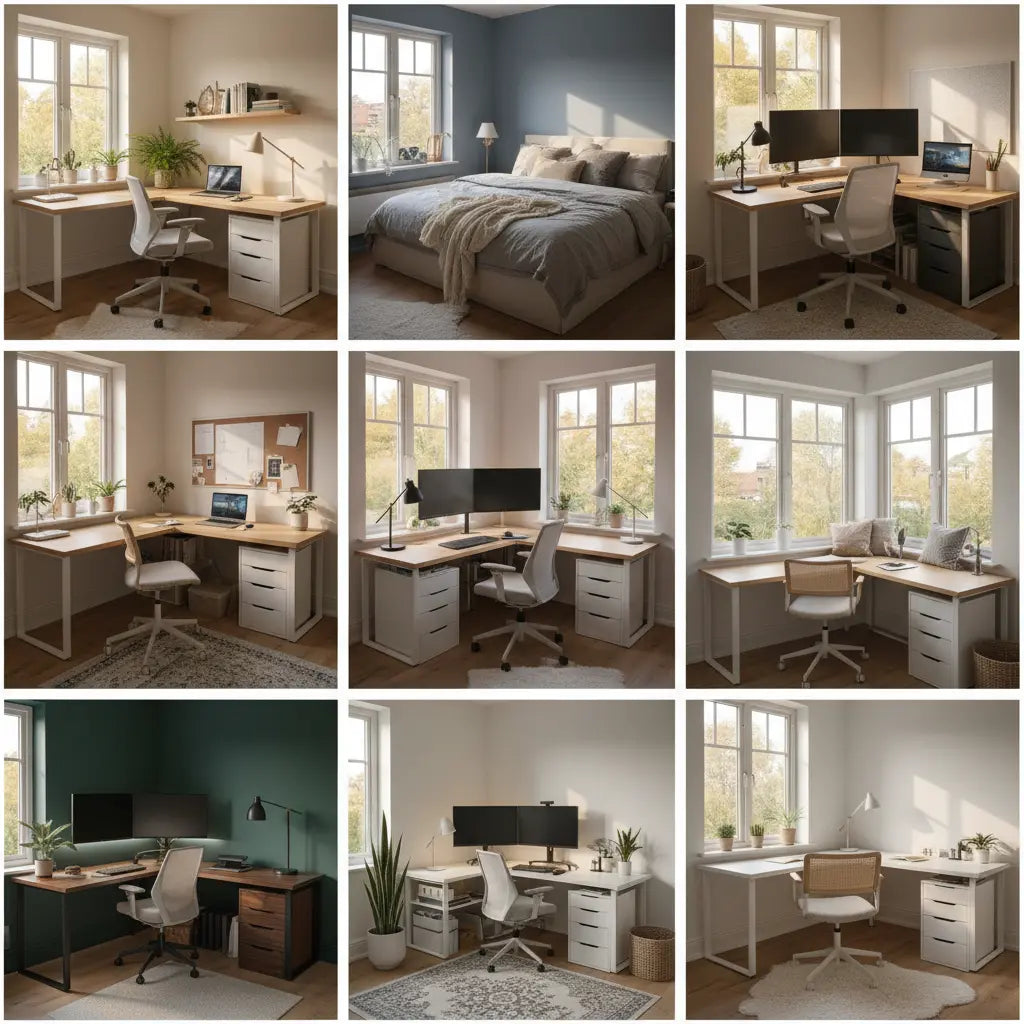
The most common layout involves placing the desk directly into a corner where two walls meet. This "Corner Hugger" strategy is excellent for stability, as the walls provide a natural brace for the desk frame. However, a common mistake is sitting directly in the corner "apex." According to 2026 HFES (Human Factors and Ergonomics Society) guidelines, sitting in the deep corner can create an ergonomic "dead zone" where your reach is restricted. Instead, position your primary monitor on one arm of the "L" and use the other arm for secondary tasks or storage.
To ensure long-term durability, check the weight distribution. L-shaped desks with monitor mounts allow you to clear the desk surface, but they also shift the center of gravity. Ensure the desk is level and consider using wall anchors if you are mounting multiple heavy displays on a lightweight frame. You can browse our L-shaped desk collection to find models with reinforced steel frames designed for this type of setup.
2. The Window-Facing Vista to Reduce Eye Strain
Placing your L-shaped desk in front of a window offers natural light and a "long-range" view, which helps reduce digital eye strain by allowing your eyes to periodically refocus on distant objects. In this layout, one side of the desk sits against the window wall, while the other extends along the perpendicular wall.
A critical consideration here is glare management. Position the desk so the window is to your side rather than directly behind or in front of your monitors. If you must face the window, use sheer curtains or adjustable blinds to diffuse the light. Additionally, be mindful of bedroom-specific outlet placement; windows often lack nearby power sources, so you may need high-quality, surge-protected extension cords routed neatly along the baseboards to power your setup.
3. The Bedside Extension as a Dual-Purpose Nightstand
In ultra-small bedrooms, you may not have room for both a desk and a nightstand. The "Bedside Extension" layout solves this by placing one arm of the L-shaped desk directly next to the bed. This shorter arm serves as your nightstand for a lamp, phone, and books, while the longer arm extends toward the rest of the room as your primary workspace.

This layout requires a desk with a finished back if it isn't fully against a wall. It’s a perfect scenario for a 48-inch LED gaming desk with monitor stand, where the built-in LED lighting can double as ambient bedside lighting in the evening. This dual-functionality is a hallmark of modern space optimization.
4. The Room Divider for Psychological Zoning
One of the biggest challenges of a bedroom office is the lack of mental separation between "work mode" and "sleep mode." The "Room Divider" layout addresses this by placing one arm of the desk against the wall and the other extending out into the room, perpendicular to the wall. This creates a physical barrier that zones the room into two distinct areas.
By sitting with your back to the bed, you remove the visual cue of your sleeping area while you work. This psychological boundary is essential for maintaining focus. When the workday ends, the "outward" arm of the desk acts as a gatekeeper, signaling that you are leaving the office and entering your personal sanctuary.
5. The Floating Island for Improved Room Flow
If your bedroom has a large, open floor plan but limited wall space due to closets or multiple doors, the "Floating Island" layout may be your best option. In this configuration, the desk is not pushed against a wall but sits more centrally. This allows for better air circulation and can make a room feel more dynamic.
The main hurdle with a floating layout is cable management. Since you aren't against a wall, cables can become a tripping hazard. Use cable sleeves and under-desk trays to keep everything contained. For more advanced tips, refer to a complete desk setup guide to learn how to route power from the nearest outlet without creating a mess.
6. The Alcove Inset for a Custom Built-In Feel
Many older apartments or modern "nooks" have small alcoves or recessed wall areas. An L-shaped desk is the perfect tool to turn these architectural quirks into a functional office. By measuring the alcove precisely, you can find a desk that fits snugly, creating a "built-in" look that feels intentional and high-end.
In these tight spaces, lighting becomes a major factor. Standard overhead lights often cast shadows in recessed areas. Consider adding LED strips or a small clip-on lamp to the desk's hutch or monitor stand to ensure your workspace is evenly illuminated. This is particularly important for video calls where shadows can make your professional presence appear dim.
7. The Back-to-Back Duo for Shared Spaces
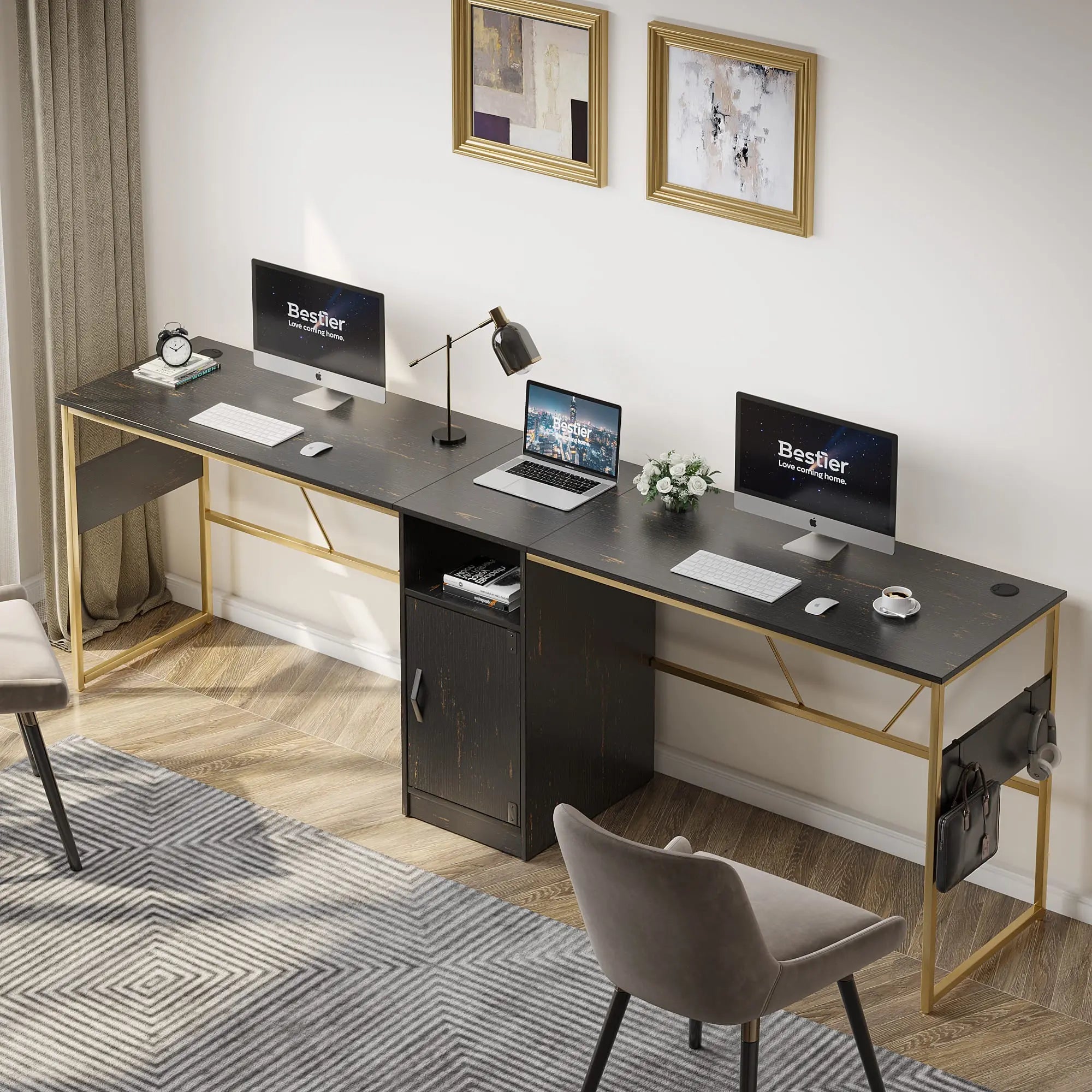
For couples or roommates sharing a bedroom, two L-shaped desks can be placed "back-to-back" to create a large, shared workstation while still providing individual "L" zones for each person. This layout maximizes the center of the room or a long wall, providing each user with their own dedicated corner.
When setting up a duo station, pay close attention to the power load. Running two full computer setups from a single bedroom circuit can sometimes trip breakers if you aren't careful. Use high-quality power strips and avoid plugging in high-draw appliances (like space heaters) on the same circuit while the computers are in use.
Layout Comparison and Stability Checklist
When choosing between these layouts, use the following table to evaluate which fits your specific needs and room constraints.
| Layout Strategy | Best For | Main Advantage | Primary Challenge |
|---|---|---|---|
| Corner Hugger | Most Bedrooms | Maximum Stability | Ergonomic "Apex" Dead Zone |
| Window-Facing | Creative Work | Natural Light | Screen Glare & Heat |
| Bedside Extension | Tiny Rooms | Dual-Purpose Furniture | Limited Privacy |
| Room Divider | Work-Life Balance | Psychological Zoning | Requires Finished Desk Back |
| Floating Island | Large Rooms | Better Airflow | Complex Cable Routing |
| Alcove Inset | Nooks/Recesses | Custom-Fit Aesthetic | Shadowing/Poor Lighting |
| Back-to-Back Duo | Shared Rooms | Individual Zones | High Power Consumption |
Stability and Safety Checklist
Before finalizing your layout, ensure you can check off these safety requirements:
- [ ] Leveling: Are all desk feet firmly on the floor? (Use shims for uneven bedroom carpets).
- [ ] Weight Balance: Is the heaviest equipment (PC tower, large monitors) placed over a leg or support beam?
- [ ] Cable Routing: Are all cords secured away from footpaths to prevent trips?
- [ ] Ventilation: Is there at least 2-3 inches of space between the PC and the wall for airflow?
- [ ] Outlet Access: Can you reach the wall outlet easily in case you need to unplug in an emergency?
Logic Summary: These recommendations assume the use of standard MDF or wood-composite desks. For solid wood or heavy metal desks, the stability concerns are lower, but the floor-load capacity of the room should be considered in older buildings.
Essential Tips for a Productive Bedroom Office
To truly optimize your small space, you need more than just a good layout. You need a holistic approach to your environment. Start by consulting top L-shaped desk recommendations to see which models currently lead the market in durability and design.
Once your desk is in place, focus on the details. Cable management is often the difference between a professional-looking office and a cluttered bedroom. Use velcro ties and under-desk baskets to keep power bricks and excess cord length out of sight. This not only looks better but also makes cleaning much easier. Remember that a bedroom office is a dual-use space; keeping it tidy is essential for getting a good night's sleep.
FAQ
What is the best L-shaped desk for a very small bedroom? For extremely tight spaces, a compact model like a 42-inch or 48-inch desk is usually the best choice. These sizes provide enough room for a laptop and a second monitor without overwhelming the room's footprint. Look for desks with integrated storage, such as shelves or a small cabinet, to maximize vertical space and eliminate the need for extra furniture.
How do I manage cables if my desk is in the middle of the room? When using a "Floating Island" or "Room Divider" layout, cable management is critical for safety and aesthetics. Use a "cable spine" or flexible sleeve to bundle all cords coming from the desk into a single, neat tube. Route this tube along the floor to the nearest outlet, and use a low-profile cord cover (racetrack) to secure it to the floor and prevent tripping.
Is it bad for ergonomics to sit in the corner of an L-shaped desk? While it's tempting to sit right in the middle of the "L," it can actually be poor for your ergonomics. Sitting in the apex often forces you to reach further for your keyboard or mouse, leading to shoulder and neck strain. It is generally recommended to sit centered on one of the straight arms of the desk, using the other arm for secondary equipment or as a writing surface.
How can I stop my L-shaped desk from wobbling on carpet? Bedroom carpets can make desks feel unstable, especially if they have a thick pile. To fix this, ensure your desk has adjustable leveling feet. If it doesn't, you can use small furniture shims or a hard plastic chair mat to create a more stable, level surface. For lightweight desks, placing heavier items like a PC tower on the bottom shelf can also help lower the center of gravity and increase stability.
Can I use an L-shaped desk as a nightstand? Yes, this is a highly effective space-saving strategy known as the "Bedside Extension" layout. By placing one arm of the desk next to your bed, you can use it to hold a lamp, alarm clock, and other nighttime essentials. This eliminates the need for a separate nightstand, freeing up several square feet of floor space in a small bedroom.
How do I deal with shadows in a corner desk setup? Corners are notorious for being dark and prone to shadows. To combat this, use a combination of lighting sources. A dedicated desk lamp with an adjustable arm allows you to direct light exactly where you need it. Additionally, installing LED light strips under any shelves or along the back edge of the desk can provide a soft, ambient glow that fills in the shadows and reduces eye strain.
References
Government / Standards / Regulators
Platform official docs & policies
Industry associations / research institutes / market reports
- State of the Remote Workforce Report 2025/2026
- National Association of Home Builders (NAHB) - Home Office Trends
Community
- r/HomeOffice - Small Space Layout Discussions (Intent only; not authoritative)
- r/Battlestations - L-Shaped Desk Inspiration (Intent only; not authoritative)
