



Summary
Organizing a small kitchen requires a strategic approach to vertical storage, and a high-quality bakers rack is the most effective solution for housing bulky appliances like air fryers and microwaves. By transitioning these high-use items from limited counter space to a dedicated, multi-tier storage unit, homeowners can reclaim valuable prep areas while ensuring proper ventilation and electrical safety for their devices.
Key takeaways
- Ventilation is non-negotiable: Air fryers require at least 5 to 8 inches of rear and side clearance to prevent heat damage to surrounding surfaces and ensure appliance longevity.
- Weight capacity matters: Choose a rack with a static load rating that exceeds your total appliance weight by at least 50% to account for the dynamic force of opening and closing heavy baskets.
- Electrical safety first: High-wattage appliances like air fryers (1500W–1800W) should ideally be plugged into dedicated outlets or high-quality integrated power strips to avoid circuit overloads.
- Material integrity: When using engineered wood racks, verify compliance with engineered wood safety standards guide to ensure the materials can withstand the specific humidity and temperature variables of a busy kitchen.
Reclaiming Your Kitchen: The Rise of the Appliance-Focused Bakers Rack
In 2026, the modern kitchen is defined more by its high-performance appliances than its square footage. The air fryer, once a niche gadget, has become a daily essential, often joined by pressure cookers, espresso machines, and high-speed blenders. While these tools revolutionize home cooking, they also create a significant "countertop creep" that leaves little room for actual food preparation. This is where the specialized bakers rack transitions from a decorative piece to a critical piece of kitchen infrastructure.
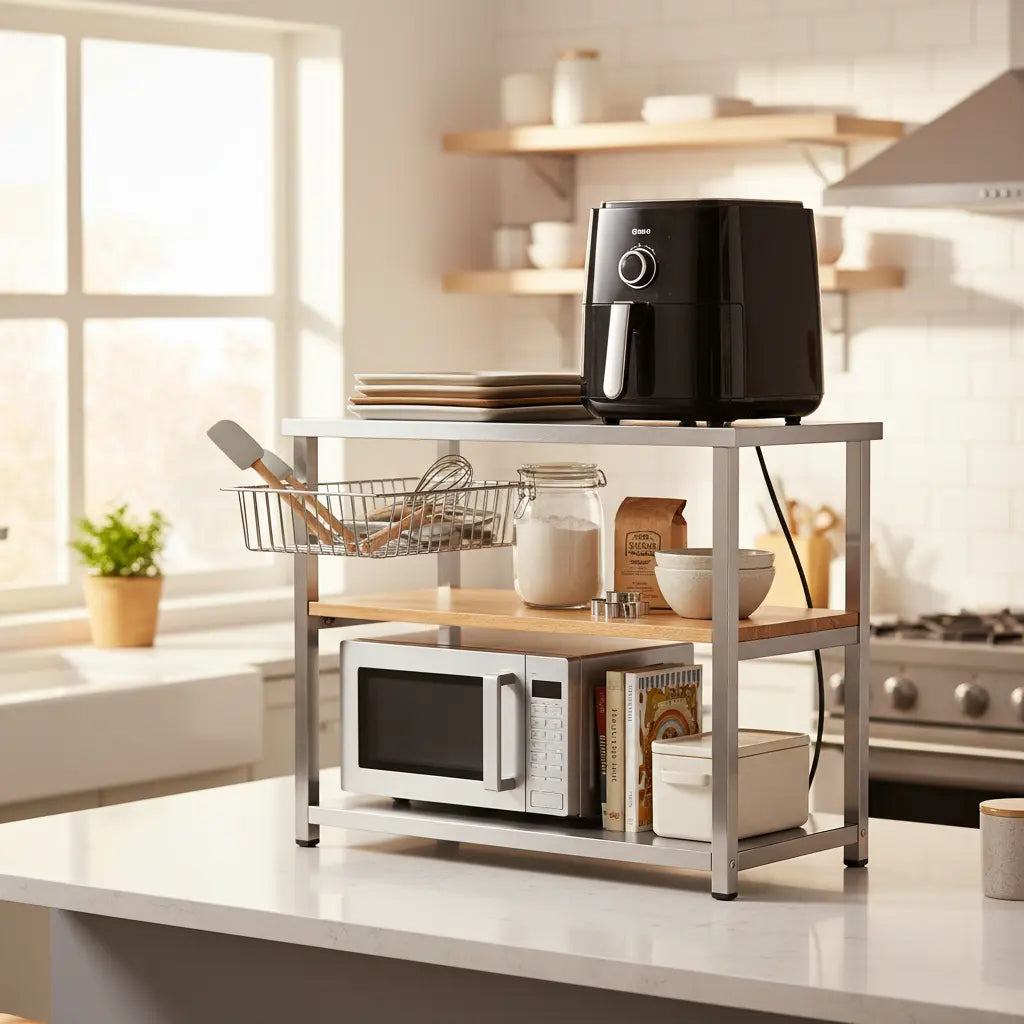
Unlike standard shelving, a dedicated microwave stand bakers rack with cabinet is engineered to handle the specific dimensions and weight of modern kitchen tech. By moving these bulky items to a vertical station, you aren't just tidying up; you are creating a functional "appliance garage" that optimizes your workflow. This shift allows for a clearer distinction between prep zones and storage zones, which is a hallmark of professional kitchen design adapted for the home.

Essential Safety: Heat Clearance and Ventilation Requirements
One of the most common mistakes in kitchen organization is placing heat-generating appliances in tight, enclosed spaces. Air fryers operate by circulating high-temperature air, and the exhaust vents—usually located at the rear—can reach temperatures exceeding 160°F (71°C). If placed too close to a wall or a cabinet back, this heat can cause paint to peel, wallpaper to bubble, or even damage the internal components of the air fryer itself.
When selecting a storage solution from a complete bakers racks collection, prioritize units with open-back designs or significant depth. A rule of thumb for 2026 appliances is to maintain a minimum of 6 inches of clearance behind the unit. This allows the hot air to dissipate naturally rather than being trapped against a vertical surface.
Logic Summary: These clearance recommendations are based on standard manufacturer safety guidelines and National Fire Protection Association (NFPA) general appliance safety principles. While some smaller models may require less space, the 6-inch buffer is a safe heuristic for the high-capacity air fryers common in 2026.
Furthermore, the material of the shelf itself is a safety factor. Many modern racks use engineered wood for its aesthetic versatility and cost-effectiveness. However, sustained heat can accelerate the off-gassing of binders used in these materials. It is essential to choose furniture that adheres to rigorous environmental standards. For a deeper understanding of how heat interacts with furniture materials, refer to the engineered wood safety standards guide, which details the critical safety standards like CARB Phase 2 and EPA TSCA Title VI that protect indoor air quality.
Weight Capacity and Structural Integrity: Static vs. Dynamic Loads
When evaluating a bakers rack for heavy appliances, most consumers only look at the static weight limit—the amount of weight a shelf can hold while the object is sitting still. However, kitchen appliances introduce "dynamic loads." For example, when you pull out a heavy, food-laden air fryer basket or press down firmly on a stand mixer, you are applying additional force that exceeds the static weight of the machine.
A standard air fryer can weigh between 12 and 20 pounds, while a mid-sized microwave often reaches 35 to 50 pounds. If you add a coffee station and a toaster oven, a single rack could easily be supporting over 100 pounds of equipment. To ensure long-term stability and prevent shelf bowing, look for racks with reinforced metal frames and high-density shelving.
| Appliance Type | Average Weight (lbs) | Recommended Clearance (inches) | Typical Wattage (W) |
|---|---|---|---|
| Large Air Fryer | 15–22 | 6" Rear / 4" Sides | 1500–1800 |
| Mid-size Microwave | 30–45 | 3" Rear / 2" Sides | 800–1200 |
| Espresso Machine | 20–30 | 2" Rear / 2" Sides | 1200–1500 |
| Toaster Oven | 15–25 | 6" Top / 4" Sides | 1200–1500 |
| Stand Mixer | 25–30 | N/A (Static) | 300–600 |
Electrical Management for High-Wattage Kitchen Clusters
The convenience of a bakers rack is often hampered by the "spaghetti mess" of power cords. More importantly, plugging multiple high-wattage appliances into a single outlet or a cheap power strip is a significant fire hazard. An air fryer drawing 1800 watts essentially maxes out a standard 15-amp kitchen circuit. If a microwave on the same circuit kicks in simultaneously, the breaker will likely trip.
To solve this, many modern storage units, such as a 5-tier kitchen bakers rack with power outlets, come with integrated power strips. When using these, ensure the unit's power cord is of a heavy-gauge variety (at least 14 AWG) and that you are mindful of the total load.
Electrical Safety Checklist:
- Check the wattage of every appliance you plan to store.
- Avoid "daisy-chaining" power strips (plugging one into another).
- Ensure the bakers rack cord is not pinched against the wall, which can damage the insulation.
- If your kitchen has GFCI (Ground Fault Circuit Interrupter) outlets, use them for your appliance station to provide an extra layer of protection against electrical faults.

Organizing Your Small Kitchen: A Step-by-Step Layout Guide
Organizing a small kitchen is about more than just finding a spot for everything; it's about ergonomic flow. When setting up your bakers rack, place the most frequently used items—likely your air fryer or microwave—at "counter height" (typically 34 to 36 inches from the floor). This prevents unnecessary bending or reaching with hot, heavy food.
- The Heavy Base: Place the heaviest items, such as large bags of flour or rarely used stand mixers, on the bottom shelf. This lowers the center of gravity and increases the overall stability of the unit.
- The Action Zone: Use the middle shelf for your air fryer. This provides the best ergonomic access and ensures the heat exhaust is at a safe level, away from the floor and ceiling.
- The Coffee Station: If your rack has a smaller upper shelf, it’s the perfect spot for an espresso machine or coffee pods.
- Vertical Accessories: Utilize S-hooks on the side of the metal frame to hang oven mitts, tongs, and air fryer liners. This keeps essential tools within arm's reach without cluttering the shelves.
For those debating between different furniture types, a bakers rack vs kitchen island comparison can help determine which layout best suits your specific floor plan. While islands offer more prep surface, bakers racks provide superior vertical storage for those with limited floor space.
Stability and Seismic Safety for Tall Storage Units
As bakers racks grow taller to maximize vertical space, stability becomes a paramount concern. A top-heavy rack is a tipping hazard, especially in households with children or in regions prone to seismic activity. Even the simple act of pulling a stuck air fryer basket can cause a lightweight rack to wobble.
To mitigate this, always use the anti-tip kits provided by manufacturers to anchor the unit to a wall stud. If your flooring is uneven, look for racks with adjustable leveling feet. These allow you to compensate for floor slopes, ensuring the shelves remain perfectly horizontal. This is particularly important for appliances with liquids, like coffee makers or slow cookers, where an unlevel surface can lead to spills or uneven cooking.
Logic Summary: Wall anchoring is recommended for any furniture over 30 inches tall that supports more than 50 pounds. This is a standard safety recommendation from the Consumer Product Safety Commission (CPSC) to prevent tip-over injuries.
Aesthetic Integration: Beyond Utility
While the primary goal is storage, a bakers rack shouldn't look like a piece of industrial warehouse equipment in your home. Modern designs often blend wood textures with metal frames to create an "industrial chic" or "modern farmhouse" look. You can soften the appearance of your appliance station by incorporating modern bakers rack styling tips, such as adding a small potted herb or using uniform glass jars for dry goods. This transforms a utility station into a curated part of your home decor.
FAQ
Can I put an air fryer on a wooden bakers rack? Yes, you can place an air fryer on a wooden bakers rack, provided the wood has a heat-resistant finish and you maintain proper ventilation. It is highly recommended to use a heat-resistant silicone mat under the air fryer to protect the wood from direct heat transfer and potential grease spills. Additionally, ensure the rack is made from high-quality materials that meet safety standards for temperature and humidity fluctuations.
How much weight can a typical bakers rack hold? Weight capacity varies significantly by design, but a high-quality kitchen bakers rack typically supports between 50 and 100 pounds per shelf. Always check the manufacturer's specific load ratings before loading it with heavy appliances like microwaves and stand mixers. Remember that the bottom shelf is usually the strongest and should be used for the heaviest items to maintain a low center of gravity.
Does an air fryer need a dedicated circuit? Most air fryers draw between 1500 and 1800 watts, which is the maximum capacity for a standard 15-amp household circuit. While they don't strictly require a dedicated circuit, running another high-wattage appliance (like a microwave or toaster) on the same circuit at the same time will likely trip your circuit breaker. For the best experience, try to plug your air fryer into an outlet that isn't sharing a heavy load with other major kitchen tools.
How do I prevent my bakers rack from wobbling? To prevent wobbling, ensure the rack is placed on a level surface and utilize the adjustable leveling feet if included. Always place the heaviest appliances on the lower shelves to improve stability. Most importantly, use a wall-anchoring kit to secure the unit to a wall stud, which prevents tipping and provides a much sturdier feel when opening and closing appliance doors or baskets.
Can I use a power strip on my bakers rack for multiple appliances? You can use a power strip, but it must be a high-quality, heavy-duty surge protector rated for the total wattage of your appliances. Never plug an air fryer into a thin, light-duty extension cord or a cheap power strip, as these can overheat and melt. The best solution is a bakers rack with a built-in, UL-certified power station designed specifically for kitchen appliance loads.
References
Government / Standards / Regulators
- U.S. Consumer Product Safety Commission (CPSC) - Furniture Tip-Over Prevention
- National Fire Protection Association (NFPA) - Cooking Safety
