
Summary
Maximizing a small kitchen's footprint in 2026 requires moving beyond traditional cabinetry and embracing vertical storage solutions like heavy-duty bakers racks. By centralizing high-wattage appliances such as microwaves and air fryers onto a single, reinforced unit, you can reclaim up to 40% of your primary counter space while ensuring optimal heat dissipation and electrical safety.
Key takeaways
- Vertical Efficiency: A multi-tier bakers rack can consolidate the footprint of three or more large appliances into less than 4 square feet of floor space.
- Safety First: High-wattage appliances like air fryers require at least 4-5 inches of rear and side clearance to prevent heat-related damage to furniture surfaces.
- Weight Management: Always place the heaviest appliance (typically the microwave) on the reinforced middle shelf to maintain a low center of gravity and prevent tipping.
- Electrical Load: Ensure your rack's integrated power strip is UL-certified and that you avoid running multiple high-draw appliances simultaneously on the same circuit.
- Material Standards: Choosing furniture that meets engineered wood safety standards ensures long-term indoor air quality, especially when materials are exposed to kitchen heat.
Why Vertical Storage is the Solution for Small Kitchen Footprints
In the modern urban kitchen, counter space is often the most contested real estate. As we move through 2026, the trend toward multi-functional small appliances—from 12-in-1 air fryers to smart microwave ovens—has only increased the demand for smart storage. A bakers rack serves as a dedicated "appliance station," allowing you to move these bulky items off your primary prep surfaces.
Unlike standard shelving, a kitchen-specific bakers rack is designed with the depth and height clearance necessary for appliance operation. When deciding between a bakers rack vs kitchen island for small spaces, the bakers rack often wins for those with narrow floor plans because it utilizes wall height rather than expanding horizontally. This "skyline approach" to kitchen design keeps your essential tools within reach without cluttering your workflow.
Logic Summary: This recommendation assumes a kitchen size of less than 100 square feet where floor space is limited. Vertical storage is prioritized here because it offers the highest storage-to-footprint ratio.
Calculating Weight Capacity for Heavy Kitchen Appliances
One of the most common mistakes in small kitchen organization is underestimating the cumulative weight of modern appliances. A standard mid-sized microwave can weigh between 35 and 55 pounds, while a large-capacity air fryer or a professional-grade stand mixer adds another 20 to 30 pounds each.
When selecting a microwave stand bakers rack with cabinet, you must verify the static load capacity of each individual shelf. Most high-quality racks feature a reinforced "main" shelf designed to hold up to 100 pounds, making it the ideal spot for your microwave.
Appliance Weight Reference Table
| Appliance Type | Average Weight (lbs) | Recommended Shelf Placement |
|---|---|---|
| Mid-sized Microwave | 40 - 55 | Main/Middle (Reinforced) |
| Large Air Fryer | 15 - 25 | Middle or Lower |
| Stand Mixer | 25 - 30 | Middle (for stability) |
| Toaster Oven | 10 - 15 | Upper |
| Coffee Maker | 5 - 10 | Top or Side Wing |

Logic Summary: These weight ranges are based on 2026 market averages for consumer-grade appliances. Always check your specific appliance's manual, as professional or "commercial-style" home units may exceed these estimates.
Managing Heat Dissipation and Surface Safety
Air fryers and toaster ovens operate by circulating high-temperature air, often reaching internal temperatures of 400°F or higher. The exterior housing of these appliances can become significantly hot to the touch, and the exhaust vents release concentrated heat that can damage nearby walls or furniture finishes over time.
To ensure longevity for both your appliances and your furniture, follow the "Rule of Five": maintain at least five inches of clearance from any vertical surface and five inches of overhead space. This prevents heat from becoming trapped, which can cause the appliance's internal thermal fuse to trip or lead to the warping of engineered wood shelves.
For those using a 5-tier kitchen bakers rack with built-in power outlets, ensure that the power cord of the air fryer is not resting against the back of the unit where heat is exhausted. Utilizing heat-resistant mats under air fryers can provide an extra layer of protection for the shelf surface.
Electrical Requirements for Dual High-Wattage Appliances
A significant "hidden" challenge of organizing multiple appliances on one rack is the electrical demand. A microwave typically draws 1,000 to 1,500 watts, while an air fryer can draw 1,500 to 1,800 watts. If both are plugged into the same power strip and operated simultaneously, they will likely exceed the 15-amp or 20-amp limit of a standard household circuit, causing a breaker to trip.
When setting up your station, look for racks with integrated power strips that are UL (Underwriters Laboratories) or ETL certified. These certifications ensure the electrical components have been tested for safety. However, even with a certified strip, the best practice is to operate only one high-draw appliance at a time.
Logic Summary: This guidance follows standard National Electrical Code (NEC) principles for residential kitchens. It assumes a standard 120V circuit. If your kitchen has been upgraded to 240V "smart circuits" common in some 2026 new builds, capacity may be higher, but the "one-at-a-time" rule remains the safest heuristic for furniture-integrated power.
Material Integrity: Understanding CARB and TSCA Standards
When placing heat-generating appliances on furniture made from engineered wood (such as MDF or particle board), material safety becomes a primary concern. Heat and humidity can accelerate the off-gassing of formaldehyde, a chemical used in many wood adhesives.
As detailed in the authoritative guide on engineered wood safety standards, it is crucial to choose products that are CARB Phase 2 and EPA TSCA Title VI compliant. These regulations set strict limits on formaldehyde emissions, ensuring that even as your kitchen warms up during a long air-frying session, your indoor air quality remains within safe parameters.
Bestier’s commitment to these standards means that our kitchen furniture is designed with both durability and health in only. When you browse all bakers racks in our collection, you are looking at products that have undergone rigorous third-party testing to meet these environmental benchmarks.
Step-by-Step Organization for Maximum Workflow Efficiency
Organizing your bakers rack isn't just about making it fit; it's about making it work for your daily routine. Proper kitchen bakers rack organization tips emphasize the "Zone Method," where items are grouped by frequency of use and physical weight.
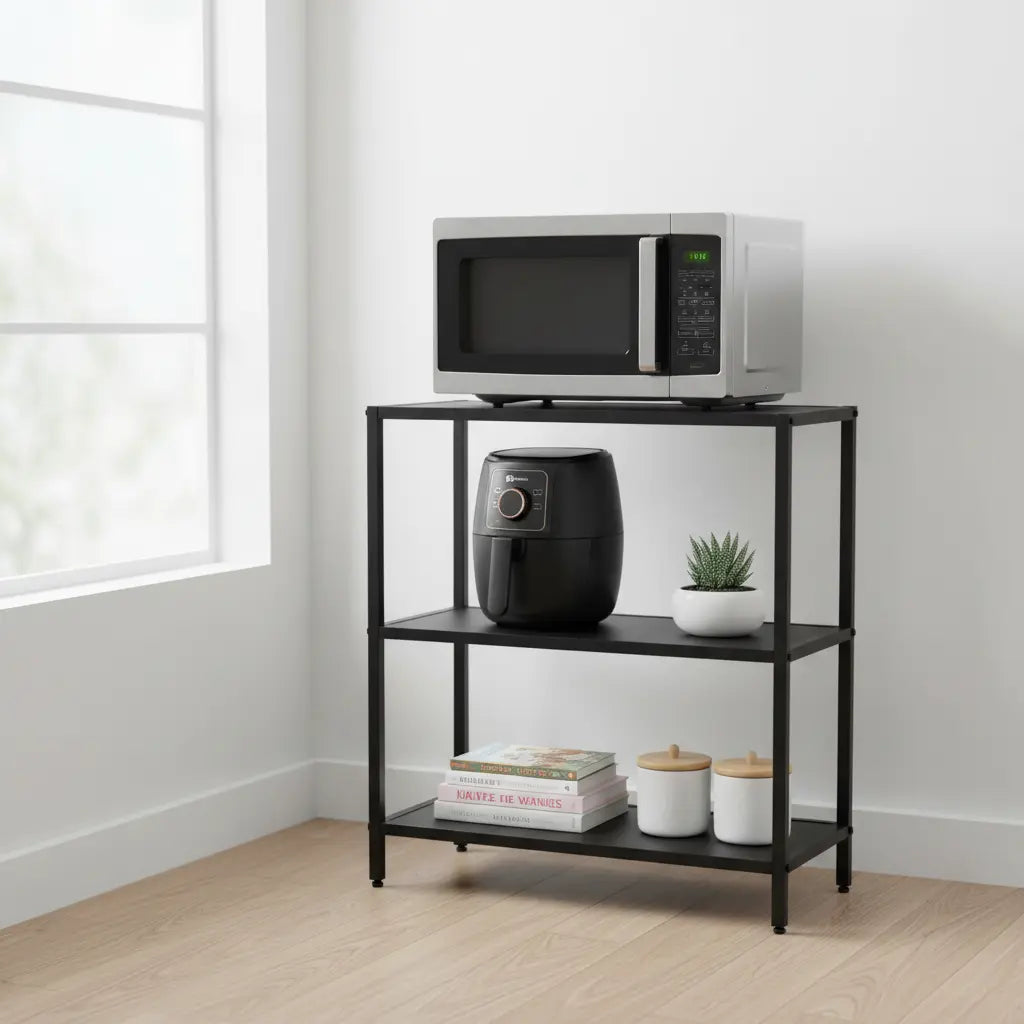
- The Anchor Zone (Middle Shelf): Place your microwave here. It’s at the perfect height for monitoring food and is supported by the rack's strongest structural point.
- The Active Zone (Counter Height): If your rack has a dedicated tabletop surface, use this for your air fryer or as a prep space for "landing" hot plates from the microwave.
- The Storage Zone (Bottom Shelves/Cabinet): Use the lower sections for heavy items like bags of flour, cast iron pans, or a microwave stand bakers rack with cabinet to hide away less attractive essentials.
- The Reach Zone (Top Shelves): Store lightweight items like spice jars, cookbooks, or decorative baskets. Avoid placing heavy appliances here, as it makes the unit top-heavy.
- The Utility Zone (Side Hooks): Utilize S-hooks for oven mitts, measuring cups, and even small pans to keep them off the shelves and within easy reach.

Ensuring Stability and Reducing Appliance Vibration
High-speed appliances like air fryers or stand mixers can create significant vibration during operation. On a less stable rack, this can lead to "walking" (where the appliance shifts slightly) or annoying rattling sounds.
To mitigate this, ensure your bakers rack is equipped with adjustable leveling feet. Small kitchens often have uneven floors, and even a 1/16th-inch gap can cause a rack to wobble. Furthermore, for any unit taller than 60 inches, we strongly recommend using the included anti-tip wall anchors. This is especially critical if you have children or pets, as the combined weight of a microwave and air fryer creates a significant hazard if the unit were to tip.
Logic Summary: Stability recommendations are based on ASTM F2057-23 safety specifications for clothing storage units, which we apply as a higher-standard heuristic for tall kitchen shelving to ensure maximum user safety.
FAQ
Can I put an air fryer on a wood bakers rack? Yes, you can safely place an air fryer on a wood or engineered wood bakers rack, provided the material is high-quality and you maintain proper clearance. It is essential to ensure the rack meets engineered wood safety standards to prevent excessive off-gassing when exposed to heat. Always leave at least 4-5 inches of space around the air fryer's vents to allow hot air to escape without damaging the wood finish.
How much weight can a typical kitchen bakers rack hold? Weight capacity varies by design, but a high-quality, heavy-duty bakers rack typically supports between 50 to 100 pounds on the main reinforced shelf and 20 to 30 pounds on auxiliary shelves. Always check the manufacturer's specifications before loading heavy appliances like stand mixers or large microwaves. Distributing the weight evenly and keeping the heaviest items on the middle or lower shelves is key to maintaining stability.
Is it safe to plug both a microwave and an air fryer into the rack's power outlet? While many racks come with integrated power strips, it is generally unsafe to run a microwave and an air fryer at the same time on the same circuit. Both appliances are high-wattage (often 1,200W-1,800W each), and their combined draw will likely trip your kitchen's circuit breaker. You can plug them both in for convenience, but you should operate them one at a time to avoid electrical overloads.
How do I prevent my bakers rack from wobbling when the air fryer is running? To prevent wobbling, ensure the rack is perfectly level by adjusting the leveling feet on the bottom of the unit. Placing a non-slip, heat-resistant silicone mat under the air fryer can also help absorb vibrations and prevent the appliance from shifting during its cycle. For taller racks, always use the provided wall-mounting hardware to secure the unit to a stud, which significantly increases overall rigidity.
What is the best height for a microwave on a bakers rack? The ideal height for a microwave is between 36 and 54 inches from the floor, which typically corresponds to the middle or "counter-height" shelf of a bakers rack. This placement allows for easy viewing of the food inside and safe removal of hot containers without having to reach too high or bend too low. This "ergonomic goldilocks zone" reduces the risk of spills and burns in a busy kitchen.
Can I use a bakers rack in a rental apartment? Absolutely. Bakers racks are excellent for rentals because they provide "instant cabinetry" without requiring any permanent modifications to the walls or floor. They are freestanding and can be easily disassembled or moved when your lease ends. Just be sure to use the anti-tip hardware; while it requires a small screw in the wall, most landlords prefer a small hole over the liability of a tipped piece of furniture.
References
Government / Standards / Regulators
- EPA: Formaldehyde Emission Standards for Composite Wood Products (TSCA Title VI)
- CPSC: Furniture Tip-Over Protection and Safety Standards
- UL Solutions: UL 962 - Standard for Household and Commercial Furnishings
Industry Associations / Research Institutes
- National Kitchen & Bath Association (NKBA): Kitchen Planning Guidelines and Access Standards
- Association of Home Appliance Manufacturers (AHAM): Appliance Safety and Performance Standards
Academic / Whitepapers
- Engineering Toolbox: Static and Dynamic Loads on Shelving Systems
- Journal of Indoor Air: Impact of Temperature on Formaldehyde Emission Rates from MDF
Community
- Reddit r/KitchenOrganization: User discussions on appliance station setups (Intent only; not authoritative)
