
Summary
Finding the ideal TV stand for a retro gaming setup in 2026 requires a shift in perspective from modern minimalist designs to heavy-duty structural integrity. Unlike lightweight flat screens, classic Cathode Ray Tube (CRT) televisions demand significant weight capacity—often exceeding 150 pounds for larger models—and deep surface areas to accommodate their protruding rear chassis. A successful retro media center must balance these structural needs with specialized shelf depths for vintage consoles like the Neo Geo AES and robust ventilation to manage the heat output of aging power supplies.
Key Takeaways
- Prioritize Weight Capacity: Ensure the top surface is rated for at least 150-200 lbs for 27-inch+ CRTs. Always include a 20% safety margin.
- Verify Shelf Depth: Aim for a minimum of 14-15 inches to accommodate deep consoles and rear cable clearance.
- Ensure Active Airflow: Use open-back designs or maintain 3-4 inches of side clearance to prevent hardware failure.
- Check Material Safety: Look for CARB Phase 2 and TSCA Title VI certifications to ensure indoor air quality.
- Measure Before Buying: Use the "Depth + 3" rule for cables and verify your CRT's weight using historical manuals or a heavy-duty scale.
The Structural Demands of CRT Televisions
Retro gaming enthusiasts know that the "holy grail" of the hobby—the CRT television—is as heavy as it is iconic. While modern 55-inch LED TVs might weigh a mere 35 pounds, a 32-inch Sony Trinitron from the late 90s can easily tip the scales at 150 pounds or more. This massive weight is concentrated in the front glass tube, creating a forward-heavy center of gravity that can cause inferior stands to bow or tip.
When selecting a Bestier TV Stand, you must look beyond the screen size recommendation and focus strictly on the weight rating. Most modern furniture is designed for the slim profile of OLEDs, meaning the surface depth is often insufficient. A CRT requires a deep, stable platform that can support the "neck" of the tube without overhanging the back edge.
CRT Weight Estimation Table
Note: These values are estimates based on historical service manuals for Sony Trinitron and JVC D-Series models. Weights vary by brand and internal shielding.
| CRT Screen Size | Estimated Weight Range | Recommended Stand Capacity (Inc. 20% Safety Margin) |
|---|---|---|
| 13" - 14" | 25 - 40 lbs | 50 lbs |
| 20" | 60 - 90 lbs | 110 lbs |
| 27" | 90 - 130 lbs | 160 lbs |
| 32" | 140 - 180 lbs | 220 lbs |
| 36" | 160 - 230 lbs | 280 lbs |

How to Measure Your CRT and Calculate Required Support
To avoid structural failure, follow these steps to verify your setup's requirements:
- Find the "Dry Weight": Check the sticker on the back of your CRT for the model number. Search for the "Service Manual" online (sites like ManualsLib or Archive.org are excellent resources).
- The Scale Test: If no manual is available, use a heavy-duty luggage scale or a standard bathroom scale (if the TV is under 100 lbs). Caution: Always have a second person help lift the unit to prevent injury.
- Measure the Footprint: Measure the width and depth of the base of the TV, not just the screen. Ensure the stand's top surface is at least 2 inches wider and deeper than the TV's base.
- Calculate Total Load: Add the weight of the TV + the weight of all consoles + 20% (Safety Factor). For example, a 150 lb TV and 20 lbs of consoles require a stand rated for at least 204 lbs.
Optimizing Shelf Depth for Classic Console Storage
One of the most common frustrations in the retro community is finding a stand where the consoles actually fit. The Neo Geo AES and the original Xbox (OG Xbox) are notoriously deep, requiring significant shelf real estate for the unit and the stiff AV cables protruding from the back.
Standard modern media consoles often feature a depth of 10 to 12 inches. For a retro enthusiast, this is a deal-breaker. You should aim for a stand with a minimum depth of 15 inches. This allows for the 12-inch depth of an original Xbox while leaving three inches of "breathing room" for SCART or component cables. If you are integrating modern systems, a Gaming Entertainment Center for PS5 can provide vertical clearance, but always double-check the horizontal depth for older hardware.
Ventilation and Heat Management for Vintage Hardware
Vintage electronics were not designed with modern thermal efficiency. Power supplies in consoles like the Sega Saturn generate considerable heat. Placing these in a tight, enclosed cabinet can lead to capacitor leakage or component failure.
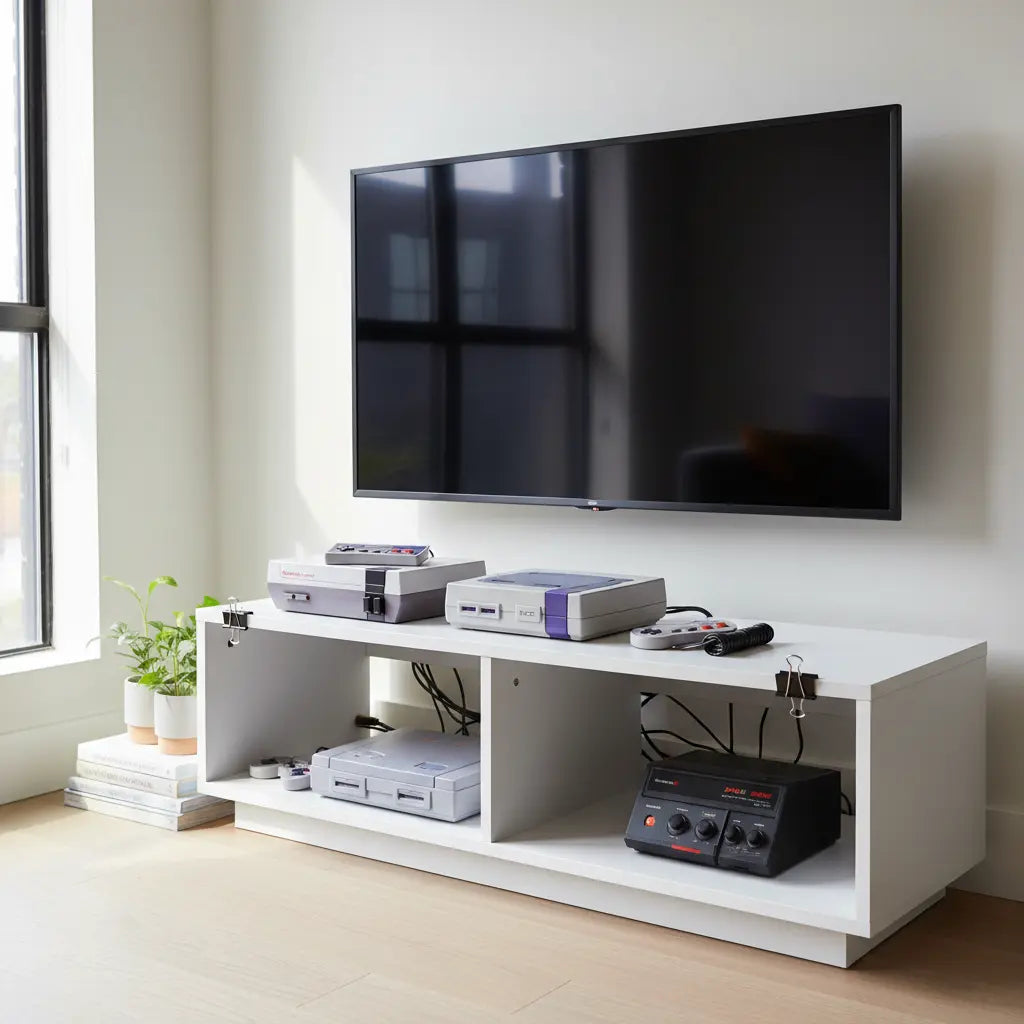
Effective heat management requires an open-back design. If you prefer a stand with a back panel, ensure there are large grommets or consider a Gaming TV Stand with Ventilation features. We recommend maintaining at least 3 inches of clearance on the sides of each console to ensure intake and exhaust vents are never obstructed.
Cable Management for the Multi-Console Collector
The "spaghetti" of cables—power bricks, RF switches, and upscalers like the RetroTINK—can become a fire hazard. A high-quality stand should offer integrated routing.
Utilizing cable management hacks such as velcro ties can keep your setup clean. Look for stands with tiered shelving to hide power strips. This is vital for CRT setups, where electromagnetic interference (EMI) from unshielded power cables can cause visual "noise" on the screen.

Material Safety and Long-Term Durability
When housing heavy vintage hardware, material quality is a safety concern. Many budget stands use low-grade particle board that can sag under constant pressure.
At Bestier, we prioritize health and structural integrity. Choose furniture that complies with strict environmental standards. Refer to the Engineered Wood Safety: A Comprehensive Guide to CARB & TSCA Standards to understand how CARB Phase 2 and EPA TSCA Title VI certifications protect you from harmful emissions. In high-humidity areas, these certified materials also better resist moisture absorption, preventing "MDF swell" that could compromise the stand's strength.
Choosing the Right Height for Retro Gaming
For modern gaming, we sit further back, but retro gaming—especially with light guns like the NES Zapper—often involves sitting closer.
A Tall LED TV Stand might work for a bedroom, but for a dedicated gaming nook, a mid-height stand (20-24 inches) is usually the "sweet spot." This places the center of the CRT at eye level while seated, reducing neck strain during long sessions.
FAQ
Can I put a CRT TV on a modern glass TV stand? Generally, no. Unless the manufacturer explicitly states a weight capacity exceeding the TV's weight by a significant margin, avoid glass. Glass can suffer from "spontaneous breakage" under the uneven, front-heavy pressure of a CRT. Wood or metal-reinforced stands are safer.
How do I prevent my TV stand from wobbling? Stability starts with a level floor. Ensure adjustable feet make firm contact. For heavy setups, choose a stand with a wide base. Ensure all cam-locks and screws are tightened fully; a loose joint can become a structural failure point under 150+ lbs.
Do I need a special stand for a 36-inch Sony Trinitron? Yes. A 36-inch Trinitron can weigh up to 230 lbs. Most standard "big box" furniture is only rated for 100-135 lbs. You must verify the "static load" rating of the top shelf specifically for heavy-duty use.
Should I use a wall mount for a CRT? This is highly discouraged for standard residential setups. Standard wall mounts and drywall studs are designed for the flat profile of modern TVs. The depth of a CRT creates massive leverage (torque) that can pull studs out of the wall. Only attempt this if using industrial-grade steel mounts anchored to reinforced masonry or structural steel, and only after consultation with a structural engineer.
Safety Disclaimer
The information provided in this guide is for educational purposes. Always prioritize the manufacturer's weight ratings for both your television and your furniture. If you are unsure about the structural integrity of your floor or wall, consult a professional contractor or structural engineer before installing heavy vintage equipment.
References
Government / Standards / Regulators
- EPA TSCA Title VI Formaldehyde Emission Standards
- California Air Resources Board (CARB) Airborne Toxic Control Measure
Industry Associations / Research Institutes
- ANSI/BIFMA X5.5 - Desk and Table Products Standards
- ASTM F2057-23 Standard Safety Specification for Clothing Storage Units
