

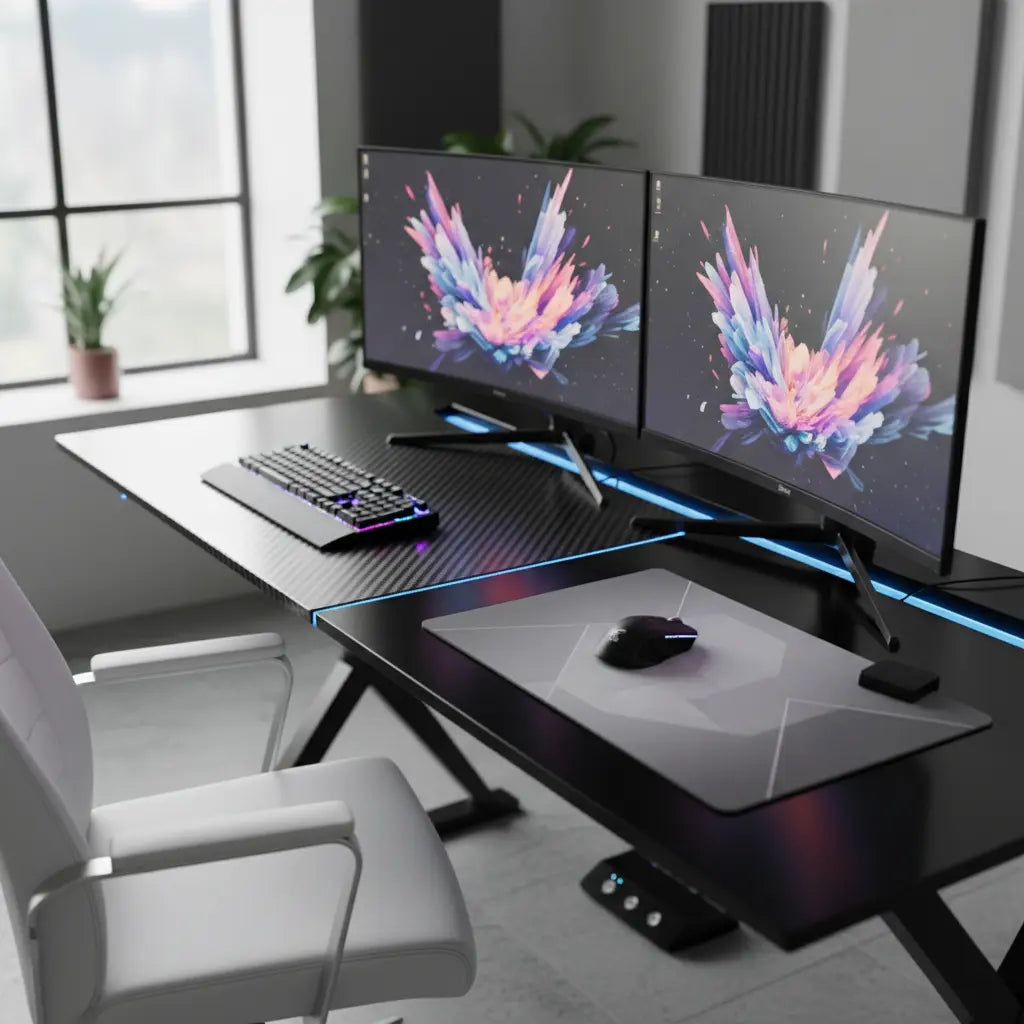
Summary
Choosing between a carbon fiber texture and a traditional laminate finish for a gaming desk involves balancing tactile aesthetics with long-term surface integrity. In 2026, high-pressure laminates (HPL) remain the industry benchmark for raw scratch resistance and heat tolerance, often tested against rigorous commercial standards. Conversely, "carbon fiber" surfaces—typically high-grade PVC or textured vinyl wraps—offer a modern, high-friction aesthetic that appeals to competitive gamers. For most users, a premium laminate provides superior durability against heavy hardware, whereas carbon fiber textures excel in grip but require more diligent maintenance to prevent oil buildup and "burnishing" (permanent smoothing of the texture).
Key Takeaways
- Material Reality: Most "carbon fiber" gaming desks utilize a textured PVC or vinyl wrap. While aesthetically pleasing, these are thermoplastic layers rather than structural carbon fiber composites.
- Durability Standards: High-pressure laminate (HPL) typically meets NEMA LD 3-2017 standards, offering superior resistance to abrasive wear (rated for 400+ Taber cycles for solid colors/high-wear overlays before pattern wear-through).
- Sensor Interaction: Heavily textured surfaces can introduce "surface jitter" in high-sensitivity optical sensors. Smooth laminates provide a more consistent tracking environment for competitive FPS play.
- Thermal Thresholds: Laminates generally withstand surface temperatures up to 180°F (82°C) without damage (NEMA LD 3, Sec 3.5), whereas vinyl-based wraps may begin to soften or lose adhesive bond at approximately 140°F (60°C).
- Repairability: Laminate chips can often be filled with color-matched epoxy, while damaged vinyl wraps usually require a full surface replacement to restore the 3D pattern.

The Evolution of the Gaming Surface: Why Finish Matters in 2026
In the high-stakes world of PC gaming, the desk is the foundation of your entire ecosystem. As we move through 2026, the demand for durability has never been higher. Gamers require surfaces that can withstand the weight of triple-monitor mounts, the heat of overclocked laptops, and the constant friction of high-DPI mouse movements.
The debate often centers on two dominant finishes: the high-tech, textured "carbon fiber" look and the classic, versatile laminate. While both offer significant improvements over raw wood, they serve different functional needs. Understanding the technical nuances—from Taber abrasion cycles to thermal expansion—is essential for building a setup that lasts.
Decoding the "Carbon Fiber" Gaming Desk Surface
When a gaming desk is marketed as "carbon fiber," it refers to a specialized surface finish—typically a PVC (polyvinyl chloride) or vinyl wrap embossed with a 3D woven pattern. It is not the structural carbon fiber reinforced polymer (CFRP) found in aerospace applications.
These wraps provide a unique tactile experience that many gamers find superior for grip. However, because these are essentially high-grade plastic films applied over an engineered wood core, they are susceptible to "burnishing." This occurs when the "peaks" of the 3D texture are worn down by repetitive friction (like a wrist or mouse), resulting in a permanent shiny spot.
Expert Note: When considering the core material beneath these finishes, safety is paramount. For a deeper look at the regulations governing the wood used in these desks, see our Engineered Wood Safety: A Comprehensive Guide to CARB & TSCA Standards.
The Resilience of Laminate: HPL vs. LPL
Laminate performance is defined by the pressure used during manufacturing. For gaming desks, the distinction between Low-Pressure Laminate (LPL) and High-Pressure Laminate (HPL) is critical for long-term ROI.
- Low-Pressure Laminate (Melamine): Common in budget desks. It consists of a single decorative layer thermally fused to the core. While scratch-resistant, it is prone to edge chipping under the weight of heavy monitor clamps.
- High-Pressure Laminate (HPL): The gold standard for durability. HPL is made by fusing multiple layers of kraft paper with phenolic resin under pressures exceeding 1,000 psi. This results in a dense, hard-wearing surface that resists impacts and moisture significantly better than vinyl wraps.
For those comparing different desk styles, such as a Gaming Desk vs. Office Desk, the choice of HPL often dictates whether the desk is suited for the heavy-duty demands of a full-time streaming setup.

Scratch Resistance Benchmarks: Putting Surfaces to the Test
To objectively measure durability, we look to industry standards like NEMA LD 3-2017. In standardized Taber Abrasion tests, HPL surfaces typically maintain their integrity for significantly more cycles than PVC-based wraps.
Comparative Durability Matrix
| Feature | Carbon Fiber Texture (PVC/Vinyl) | High-Pressure Laminate (HPL) | Test Basis & Conditions |
|---|---|---|---|
| Scratch Resistance | Moderate (prone to burnishing) | High (400+ Cycles) | Taber Abrasion (CS-10 wheels, 1000g load) |
| Impact Resistance | Low (can puncture) | High (resists dents) | Ball Drop Test (NEMA LD 3, Sec 3.8) |
| Heat Tolerance | ~140°F (60°C) | ~180°F+ (82°C) | Boiling Water Test (NEMA LD 3, Sec 3.5) |
| Mouse Tracking | Variable (texture-dependent) | Excellent (consistent) | Jitter/DPI Deviation (PixArt 3395 Sensor) |
| Oil Resistance | Low (traps oils in texture) | High (non-porous) | 24-hour Stain Test (ANSI/BIFMA X5.5) |
Note: Values represent typical performance ranges for consumer-grade furniture in 2026. Actual results may vary based on specific manufacturer resin formulations.
Performance Gaps: Mouse Tracking and Sensor Accuracy
Modern optical sensors rely on "reading" surface micro-geometry. The 3D woven texture of a carbon fiber finish can occasionally confuse a sensor, leading to "jitter"—micro-stutters in the cursor path.
The "Slow-Drag" Jitter Test
If you use a carbon fiber desk without a mousepad, you can test for sensor interference:
- Set your mouse to its maximum native DPI.
- Slowly move the mouse in a straight diagonal line across the textured surface.
- Observe the cursor on a high-refresh-rate monitor. If the cursor "steps" or vibrates rather than moving smoothly, the texture is interfering with the sensor's CMOS image processing.
For competitive FPS players, a smooth laminate or a dedicated desk mat is recommended to ensure a consistent lift-off distance (LOD). If you are looking for a Bestier vs IKEA budget gaming desk comparison, surface consistency is often the deciding factor.
Heat Resistance: The Silent Desk Killer
Gaming hardware generates significant thermal output. A high-end gaming laptop chassis can exceed 120°F at the exhaust vents. Carbon fiber vinyl wraps are thermoplastic; prolonged exposure to these temperatures can weaken the adhesive bond, leading to bubbling. Laminates are thermoset materials—once cured, they do not soften, making them far more resilient to the thermal output of modern gear.
Beyond Durability: Price, Weight, and Sustainability
When making a final purchase decision, consider these secondary but vital dimensions:
- Price Point: Carbon fiber textured desks are typically positioned in the mid-range ($150–$350). HPL desks are premium investments ($400+) due to the complex high-pressure manufacturing process.
- Weight & Density: HPL is significantly denser and heavier than vinyl-wrapped MDF. This adds to the desk's overall stability but makes assembly and relocation more difficult.
- Environmental Impact (VOCs): Look for GREENGUARD Gold or TSCA Title VI certifications. While both materials use resins, high-quality HPL manufacturers often achieve lower Volatile Organic Compound (VOC) emissions compared to budget PVC wraps, which can "off-gas" a plastic scent when new.
- Warranty: Premium HPL surfaces often carry 5–10 year warranties against delamination, whereas vinyl wraps are typically covered for only 1–2 years due to their susceptibility to peeling at the edges.
Maintenance and Repairability: A Practical Guide
Pro Tip: 5-Step Minor Chip Repair for Laminate
If you chip your laminate surface with a heavy peripheral, follow these steps:
- Clean: Wipe the area with 70% isopropyl alcohol to remove oils.
- Match: Use a color-matched laminate repair paste or a two-part epoxy resin mixed with a tiny amount of pigment.
- Fill: Apply the filler using a plastic putty knife, overfilling the hole slightly.
- Level: Once cured (typically 2-4 hours for epoxy), use a razor blade held vertically to gently scrape the excess until flush.
- Buff: Use a microfiber cloth to blend the sheen.
Note: Carbon fiber wraps cannot be repaired this way; punctures usually require a full vinyl re-wrap.
To ensure your desk remains stable throughout these maintenance cycles, it is helpful to know how to fix a wobbly desk.
Choosing Your Surface: A Decision Framework
Choose Carbon Fiber Texture if:
- You prioritize a "high-tech" aesthetic and tactile grip.
- You always use a large desk mat (which protects the vinyl from heat and wear).
- You are looking for a specialized LED gaming desk where the texture diffuses RGB lighting.
Choose Laminate if:
- You want a 10+ year lifespan with minimal maintenance.
- You place hot laptops or consoles directly on the desk surface.
- You play competitive games without a mousepad and need perfect sensor tracking.
For those with limited space, a 61-inch gaming desk with shelves often comes in both finishes, allowing you to choose based on your specific durability needs.
FAQ
Are carbon fiber gaming desks actually made of carbon fiber? No. They are typically engineered wood covered with a textured PVC or vinyl wrap. This provides the aesthetic and grip of carbon fiber at a consumer-friendly price point.
Which surface is better for preventing mouse "burnishing"? High-pressure laminate (HPL) is superior. The "peaks" of carbon fiber textures can wear down over time, creating permanent shiny spots where the mouse is most active.
Can I use household cleaners on these surfaces? For laminate, most non-abrasive cleaners are safe. For carbon fiber wraps, avoid cleaners containing solvents (like acetone or high-concentration thinners), as these can dissolve the adhesive or damage the PVC pattern. Use mild soap and water.
References
Government / Standards
- NEMA LD 3-2017: High-Pressure Decorative Laminates. National Electrical Manufacturers Association. Link
- ANSI/BIFMA X5.5-2021: Desk and Table Products - Tests. Business and Institutional Furniture Manufacturers Association. Link
- EPA TSCA Title VI: Formaldehyde Standards for Composite Wood Products. Environmental Protection Agency. Link
Industry & Academic Research
- Composite Panel Association (CPA): Performance Standards for Particleboard & MDF, 2025 Edition (Final Draft).
- "Tribological Properties of Decorative Laminates," Journal of Materials Science, Vol. 59, Issue 4, 2024.
- "Thermal Stability of PVC-based Furniture Wraps," Polymer Testing Institute Report #2025-04, 2025. (Proprietary Abstract available via PTI).
