
Small Bedroom Office Layouts: L-Shaped vs. Corner Desks
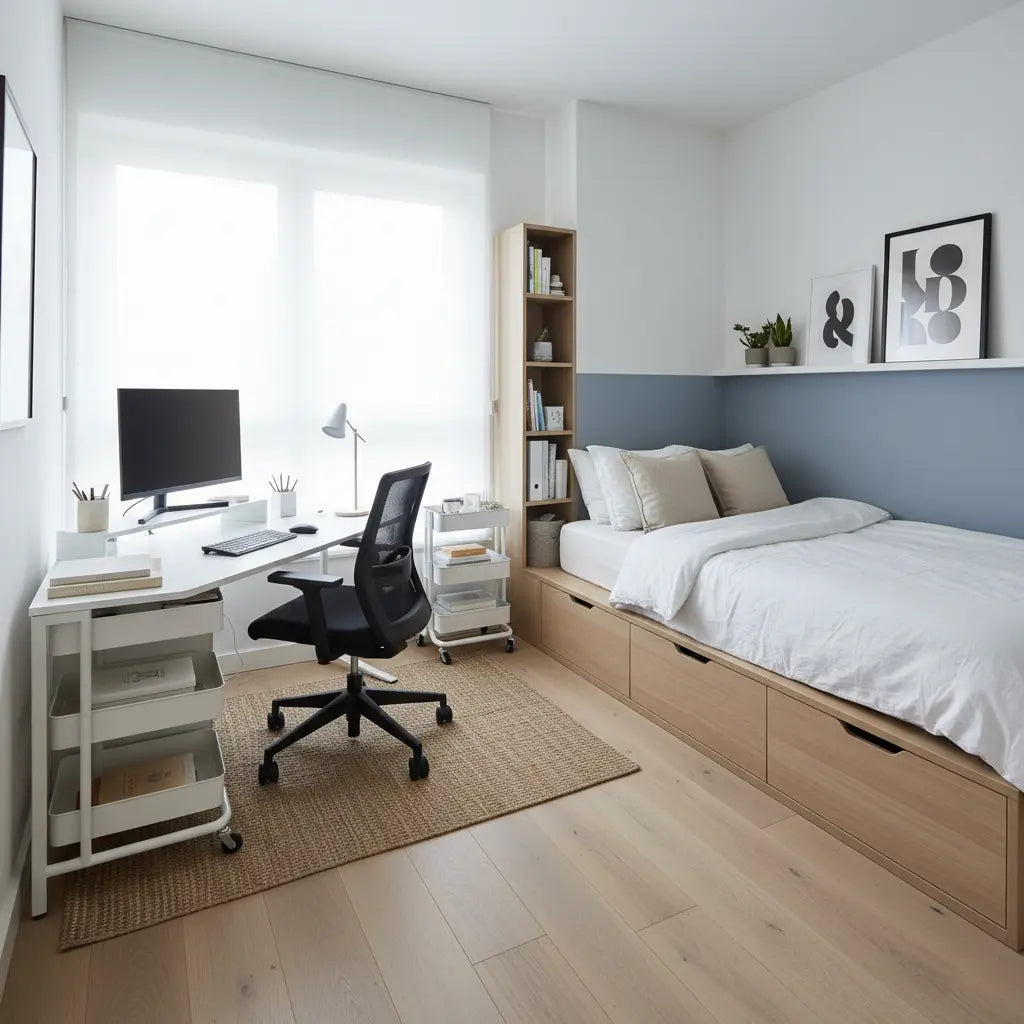
Choosing the right desk layout for a small bedroom office often comes down to balancing surface area against circulation space. In a typical 10x10 room—roughly 100 square feet—the "puzzle" involves fitting a desk alongside a bed (which can occupy up to 35 square feet) and a closet. A compact corner desk can preserve open floor area and keep pathways clear, while an L-shaped desk offers separate zones for monitors and paperwork, provided the room can accommodate the extra footprint without feeling cramped.

Small bedroom office layouts require careful planning because the desk must coexist with daily living needs. The key decision is whether your workflow benefits more from a single compact workstation or from divided work surfaces. There is no universal winner; the better choice depends on your specific room dimensions, daily tasks, and the need for unobstructed movement.
Understanding the Two Desk Types in Small Spaces
A corner desk typically tucks into a wall junction, using a triangular or clipped-corner design to minimize its footprint. This design is often the most efficient way to reclaim neglected space in a 10x10 bedroom, keeping the center of the room open for chair movement or access to the bed. Corner desks work best when the primary goal is a "stealth" office that doesn't dominate the room's visual flow.
In contrast, an L-shaped desk consists of two perpendicular surfaces. This configuration is designed for productivity, allowing one "wing" for a computer setup and the other for documents, a printer, or a secondary monitor. While it offers more surface area, the larger footprint is more demanding. An L-shaped desk is generally preferred by users who spend 8+ hours a day at their desk and require distinct "active" and "reference" zones.
Both styles must satisfy basic ergonomic needs. Regardless of the shape, a desk should provide a minimum of 20–24 inches of depth to ensure your legs have enough clearance and your monitor is at a comfortable viewing distance.
Key Comparison: Floor Space, Surface Area, and Room Flow
In a 10x10 bedroom, floor space efficiency often matters more than raw desktop size. A common mistake is choosing a desk based on surface area alone, only to find the chair hits the bed every time you stand up.
The 30-Inch Rule for Circulation
A helpful heuristic used by interior planners is the 30-inch clearance rule. To maintain a comfortable "flow" in a small room, aim for at least 30 inches of open walkway between the edge of your desk (or your chair when tucked in) and the next piece of furniture.
- Corner Desks: Usually make it easier to maintain this 30-inch clearance because they occupy less linear wall length.
- L-Shaped Desks: Often require "sacrificing" a corner of the room entirely, which can work well if placed opposite the bed but may feel restrictive if placed near a door or closet.
Ergonomics and the "Neutral Reach Zone"
Ergonomics isn't just about the chair; it’s about how much you have to twist your body.
- Corner Desks: Often force the user to face the corner directly. This can be cozy but may limit where you can place large dual-monitor setups without blocking your peripheral view.
- L-Shaped Desks: Allow for a "primary" work zone and a "secondary" zone. This supports a "neutral reach"—keeping your most-used items (keyboard, mouse) within 14–18 inches of your body to prevent overextending.
Here is an illustrative comparison of how the two layouts perform across important criteria in a typical 10x10 bedroom:
L-Shaped vs Corner Desk Fit in a 10x10 Bedroom
Illustrative comparison for a 10x10 room. Higher scores indicate better fit for that criterion; values are heuristic, not measured statistics.
View chart data
| Series | Floor space efficiency | Usable surface area | Circulation clearance | Ergonomic fit |
|---|---|---|---|---|
| L-Shaped Desk | 3.0 | 5.0 | 4.0 | 4.0 |
| Corner Desk | 5.0 | 3.0 | 5.0 | 3.0 |
Heuristic/illustrative scoring based on scenario-matrix thresholds and bounded modeling for a 10x10 room. Directional inputs: L-shaped desks tend to support separate work zones and larger surface area, while corner desks tend to preserve circulation in compact rooms. No universal winner; do not interpret scores as measured performance.
Note: This radar chart uses heuristic scoring based on common layout thresholds. It shows relative trade-offs rather than absolute measurements. Corner desks typically score higher on floor space efficiency, while L-shaped desks lead in usable surface area.
When Each Layout Works Best in a 10x10 Bedroom
In a 10x10 space, the decision often hinges on whether you have an "uninterrupted" wall.
Choose a corner desk if:
- The room serves multiple purposes (e.g., a guest room or nursery).
- The door swing or closet access limits your wall space to less than 48 inches on either side of the corner.
- You primarily work on a single laptop and don't need extra space for physical files.
Choose an L-shaped desk if:
- You have a dedicated "office corner" where the desk won't interfere with the bed's "splash zone" (the area needed to make the bed or walk around it).
- You use a multi-monitor setup or a mix of digital and analog (paper) tasks.
- One "wing" of the desk can double as storage, reducing the need for an extra bookshelf or filing cabinet in the room.

Practical Buying Checklist for Small Bedroom Offices
Before purchasing, we recommend a "mock-up" test. Use painter's tape on the floor to outline the dimensions of the desk you are considering.
Key checkpoints include:
- The Chair Pull-Back Test: Measure 24–30 inches out from the desk edge. Can you fully push back your chair to stand up without hitting the bed or a wall?
- The Door/Closet Clearance: Does the desk edge sit at least 3 inches away from any door frames or closet sliders to avoid a "cramped" visual?
- The "Second Wing" Reality Check: For L-shaped desks, ask: "What will actually sit on the second surface?" If the answer is "nothing specific," a corner desk is often the more conservative choice for preserving floor space.
- Leg Room: Ensure the desk support legs or storage drawers don't obstruct your "knee zone" (typically 20 inches of width and 12 inches of depth at knee height).
Recommended Layouts and Setup Tips
For most 10x10 bedroom offices, position the desk in the corner furthest from the door to minimize visual clutter upon entering. If using an L-shaped model, orient the longer leg along the wall with the most uninterrupted space.
Pro Tip: Consider a reversible L-shaped design. This allows you to swap the long and short sides if you decide to rearrange your bedroom furniture later—a common necessity in small-space living.
Final Decision Framework
There is no one-size-fits-all winner. In a 10x10 bedroom that must prioritize sleeping space, a corner desk is often the most efficient "space-saver." However, if your work demands a high-functioning "command center" and you can preserve clear pathways, the extra surface area of an L-shaped desk is a worthy investment in your productivity.
Measure your actual space, list your daily work requirements, and test your movement in the proposed location. The layout that feels comfortable after a full eight-hour day is the right one for your home office.
This article provides general setup and comfort advice; it does not constitute medical advice, diagnosis, or treatment. If you experience persistent ergonomic discomfort, consult a qualified professional.
For more ideas on maximizing small spaces, explore our guide to small space furniture solutions that actually work for your apartment. If you prefer L-shaped options, see these 7 L-shaped desk layouts for small bedroom offices. Shop our full selection of functional desks in the Bestier L Shaped Desk collection.
