




Summary
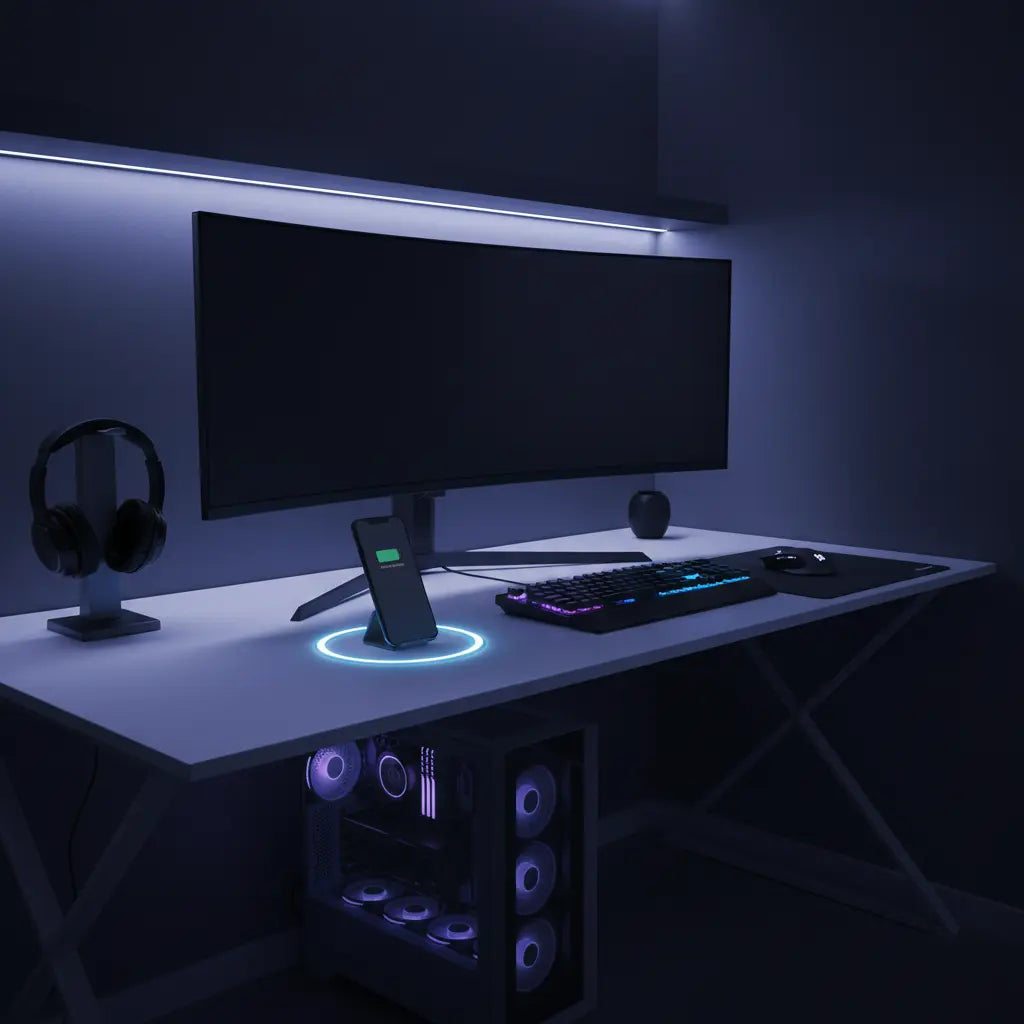
Wireless charging desks represent the pinnacle of minimalist gaming setups in 2026, integrating advanced Qi2 standards directly into the workspace to eliminate cable clutter and enhance device accessibility. By embedding magnetic alignment technology and sophisticated thermal management systems into high-quality furniture, these desks provide a seamless power solution that supports high-speed charging without compromising the structural integrity of the desk surface or interfering with wireless gaming peripherals.
Key takeaways
- Qi2 Standard Integration: Modern desks now leverage the Qi2 standard, which uses Magnetic Power Profile (MPP) technology to ensure perfect alignment and faster, more efficient charging compared to older Qi versions.
- Thermal Management: High-end desks incorporate heat dissipation layers to protect both the electronic components and the engineered wood surfaces from long-term heat exposure.
- Peripheral Harmony: Advanced shielding prevents electromagnetic interference (EMI) between the charging coils and sensitive wireless gaming mice or keyboards.
- Clutter-Free Aesthetics: Built-in charging eliminates the need for external docks and messy cables, creating a focused environment ideal for competitive gaming and content creation.
The Evolution of Gaming Desks: Why Wireless Charging is the New Standard
The transition from a simple table to a high-tech command center has been rapid. In the early 2020s, gamers were satisfied with basic cable management holes and maybe a built-in USB hub. However, as we move through 2026, the demand for a truly "invisible" tech experience has made integrated wireless charging a non-negotiable feature for many. The primary driver is the reduction of cognitive load; a clean, organized desk allows for better focus during intense gaming sessions or complex creative projects.
Beyond aesthetics, the convenience of simply setting a phone, wireless earbuds, or even a compatible gaming mouse down on a designated spot and having it charge automatically is a significant quality-of-life improvement. This shift is part of a broader trend toward smart furniture integration with gaming ecosystems, where the desk itself becomes an active participant in the user's digital life.
Understanding the Tech: Qi2 and the Shift to Magnetic Alignment
The most significant leap in wireless charging technology recently has been the widespread adoption of the Qi2 standard by the Wireless Power Consortium (WPC). Unlike the original Qi standard, which often required precise manual placement to avoid slow charging or excessive heat, Qi2 introduces the Magnetic Power Profile. This ensures that the device and the charging coil are perfectly aligned every time.
For gaming desks, this means the "sweet spot" is no longer a mystery. Manufacturers can now embed these coils under the desk surface with higher precision. This technology supports charging speeds of up to 15W or even 25W in premium models, rivaling many wired connections. When looking for the best gaming desk with wireless charging pad, it is crucial to verify if the hardware is Qi2 certified to ensure compatibility with the latest smartphones and accessories.
Logic Summary: Qi2 is recommended over legacy Qi because magnetic alignment reduces energy loss and heat generation. While legacy devices still work via backward compatibility, the full benefits of speed and thermal efficiency require Qi2-compliant hardware on both ends.
Material Science and Thermal Management: Ensuring Desk Longevity
One of the most overlooked aspects of integrated tech furniture is how heat affects the desk material over time. Wireless charging inherently generates heat as a byproduct of induction. If not properly managed, this heat can lead to the degradation of adhesives in engineered wood or even cause warping in lower-quality materials.
Top-tier manufacturers now use specialized heat sinks or thermal interface materials (TIM) between the charging coil and the desk surface. This is particularly important when using engineered wood safety standards for furniture construction as a benchmark. Ensuring that the desk meets CARB Phase 2 and EPA TSCA Title VI standards is vital for indoor air quality, as excessive heat could theoretically accelerate the off-gassing of formaldehydes if the material is not high-grade.

Impact on Gaming Performance: Addressing EMI and Peripheral Interference
A common concern among competitive gamers is whether the electromagnetic field generated by a wireless charger will interfere with their wireless gaming mouse or keyboard. High-performance gaming peripherals often operate on the 2.4GHz band, and while wireless charging typically operates at much lower frequencies (110-205 kHz), poorly shielded coils can emit electromagnetic interference (EMI) that affects signal stability.
To combat this, modern wireless charging desks feature multi-layer shielding. This ensures that the charging process remains "silent" to other electronics. When planning budget-friendly gaming room design concepts, it’s worth investing in a desk that explicitly mentions EMI shielding to avoid "ghosting" or lag in your peripherals.
| Feature | Legacy Qi (v1.2) | Qi2 (Magnetic Power Profile) |
|---|---|---|
| Alignment | Manual / Hit-or-Miss | Automatic / Magnetic |
| Max Standard Speed | 5W - 15W (Variable) | 15W - 25W+ |
| Heat Generation | Higher (due to misalignment) | Lower (optimized efficiency) |
| Interference Risk | Moderate | Low (with proper shielding) |
| Device Stability | Can slide off | Magnetically secured |
How to Choose the Right Wireless Charging Desk for Your Setup
Selecting a desk involves more than just looking for a charging icon on the surface. You need to consider the layout and how the integrated tech fits into your workflow. For instance, optimizing L-shaped gaming desk layouts often involves placing the charging pad in a "dead zone" where it won't interfere with mouse movement but remains within easy reach.
Consider the following checklist when evaluating your options:
- Power Output: Does the pad support at least 15W for fast charging?
- Number of Coils: Does it support charging multiple devices simultaneously?
- Surface Material: Is the surface scratch-resistant and thermally stable?
- Power Source: Does the desk require a single plug for all features (LEDs, motors, charging)?
- Safety Certifications: Look for FCC, CE, and WPC (Qi) certifications.
For those looking for affordable gaming desks with integrated technology, ensure that the wireless charger isn't just an afterthought but a well-integrated component with its own dedicated power supply.

Future-Proofing Your Setup: Modularity and Upgradability
As technology evolves, the wireless charging standard of 2026 may be superseded by 2030. One of the biggest "SERP gaps" in current furniture reviews is the discussion of modularity. A truly future-proof desk allows for the wireless charging module to be swapped or upgraded without replacing the entire piece of furniture.
Some innovative designs now feature a "drop-in" module system. This allows users to replace a standard Qi2 pad with a future "Qi3" or higher-wattage module as they become available. This modularity, combined with essential cable management techniques for clean setups, ensures that your investment remains relevant for years to come.
Logic Summary: Modularity is the key to sustainability in tech-integrated furniture. While fixed pads are sleeker, modular pads offer a significantly longer functional lifespan for the desk itself.
FAQ
Can I charge my wireless gaming mouse directly on the desk's charging pad? Yes, provided your gaming mouse is Qi-compatible. Many modern high-end mice from brands like Logitech and Razer support wireless charging, but some require a specific puck or adapter. Always check the manufacturer's specifications to ensure the charging pad's wattage and alignment magnets are compatible with your mouse's internal receiver.
Will the wireless charger work through a thick phone case? Most integrated desk chargers are designed to work through cases up to 3mm to 5mm thick. However, cases containing metal, magnets (unless Qi2/MagSafe compatible), or credit cards will interfere with the induction process and may cause the charger to shut off for safety. For the best experience, use a Qi2-certified case that supports magnetic alignment.
Is it safe to leave my phone on the charging pad overnight? Modern Qi2 chargers and smartphones feature sophisticated battery management systems that prevent overcharging. Once the device reaches 100%, the charger enters a "trickle" mode or shuts off entirely. Additionally, high-quality desks include thermal sensors that will cut power if the temperature exceeds safe limits, protecting both your device and the furniture.
Does the wireless charging pad consume power when not in use? Integrated chargers do have a very small "phantom" power draw (standby power) to detect when a device is placed on them. In 2026, most chargers are designed to meet strict energy efficiency standards, drawing less than 0.5 watts in standby mode. If you are concerned about energy usage, look for desks with a master power switch that can cut all electronic features at once.
Can I spill water on the wireless charging area? Most integrated charging pads are sealed beneath the desk surface or have a water-resistant cover, making them safe from minor spills. However, you should never submerge the area or allow water to seep into the power ports or internal electronics. If a spill occurs, it is best to unplug the desk and dry the area thoroughly before resuming use.
How do I know if my desk's wireless charger is Qi2 certified? You can verify certification by looking for the Qi2 logo on the product packaging or the desk itself. Additionally, the Wireless Power Consortium (WPC) maintains a public database where you can search for certified products by manufacturer or model name. Using certified products ensures the highest levels of safety, efficiency, and device compatibility.
References
Government / Standards / Regulators
- Wireless Power Consortium (WPC): Qi2 Standard Specifications and Benefits
- Federal Communications Commission (FCC): RF Exposure and Equipment Authorization for Wireless Power Transfer
- California Air Resources Board (CARB): Composite Wood Products ATCM and Formaldehyde Standards
Industry Associations / Research Institutes
- IEEE Xplore: Research on Electromagnetic Interference in Wireless Power Transfer Systems
- Furniture Industry Research Association (FIRA): Standards for Integrated Technology in Domestic Furniture
Platform Official Docs & Policies
Community
- Reddit r/GamingSetups: User Intent and Feedback on Integrated Desk Tech (Intent only; not authoritative)
