
Summary
Maximizing a cramped dorm room for both high-performance gaming and intensive study requires a strategic shift from horizontal sprawl to vertical integration and device consolidation. By leveraging Small Form Factor (SFF) technology, adhering to strict electrical safety standards like NFPA 70, and utilizing multi-functional furniture, students can create a professional-grade "battlestation-office" hybrid that respects both roommate boundaries and ergonomic health.

Key takeaways
- Reclaim Surface Area: Utilize vertical storage solutions like pegboards and monitor arms to free up to 40% of your desk's primary workspace.
- Optimize Hardware: Transition to Small Form Factor (SFF) PC builds or USB4/Thunderbolt 5 docking stations to reduce the physical footprint of your tech.
- Prioritize Safety: Calculate total power draw to stay within dorm circuit limits and choose furniture that meets fire safety standards for furniture materials.
- Acoustic Management: Use sound-dampening materials and quiet mechanical switches to maintain a respectful shared living environment.
- Ergonomic Integrity: Ensure all "hacks" maintain BIFMA-standard posture support to prevent long-term physical strain during marathon sessions.
Navigating the Dorm Room Challenge: Why Space Optimization Matters
Dorm rooms are notoriously compact, often providing less than 100 square feet of personal space in a shared environment. For the modern student, this small footprint must serve as a bedroom, a high-stakes study hall, and a high-performance gaming arena. The traditional approach of "fitting things where they go" often leads to a cluttered, stressful environment that hinders both academic focus and gaming performance.
In 2026, the challenge has intensified as students bring more powerful hardware and more diverse digital tools into these spaces. True optimization isn't just about tidying up; it's about engineering a multi-functional environment that adapts to different needs throughout the day. By treating every square inch as prime real estate, you can transform a standard-issue dorm desk into a sophisticated command center.
Strategic Layout: Zone-Based Design for Study and Play
The first step in any successful dorm hack is planning the layout. Rather than treating the desk as a single catch-all surface, successful setups employ zone-based layout optimization for small rooms. This involves mentally—and sometimes physically—dividing the desk into "Active Work," "Peripheral Storage," and "Gaming Core" zones.
The "Active Work" zone should be the center of the desk, kept clear of permanent hardware to allow for textbooks or notebooks. The "Gaming Core" typically occupies the rear or one side, housing the monitor and primary input devices. By defining these boundaries, you prevent "peripheral creep," where gaming gear slowly consumes the space needed for academic tasks.
Logic Summary: Zone-based design assumes that the user switches between distinct tasks (study vs. gaming). This recommendation applies to desks at least 40 inches wide; for smaller surfaces, a "swap-out" strategy using under-desk storage is preferred.
Vertical Integration: Reclaiming Desk Real Estate
When horizontal space is at a premium, the only way to go is up. Vertical integration is the most effective "hack" for dorm residents. Standard dorm desks often have a shallow depth, making it difficult to fit a large monitor and a keyboard while leaving room for wrists.
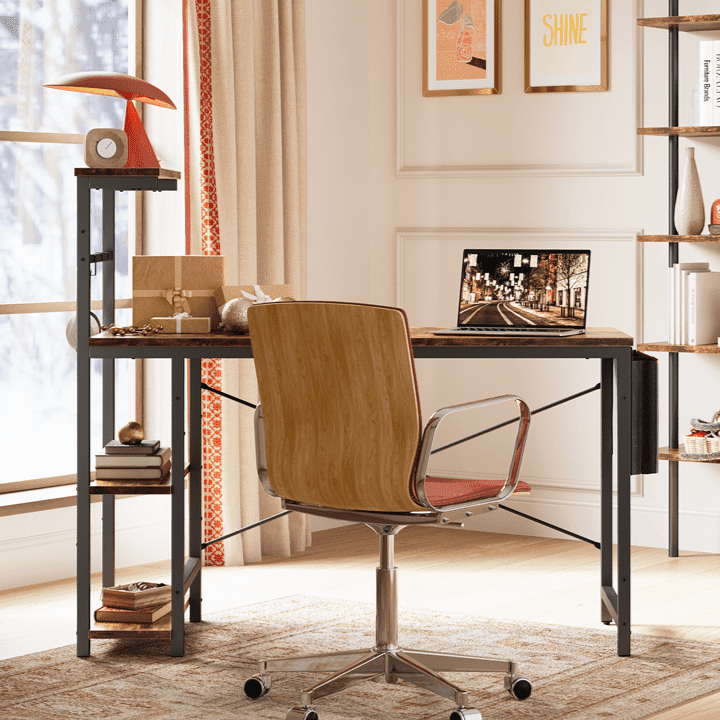
Using a monitor arm is a game-changer. By lifting the screen off the desk, you reclaim the 6-10 inches of space typically occupied by a bulky stand. This space can then be used for a laptop dock or stationery. Additionally, incorporating corner desk solutions for tight spaces or a compact L-shaped desk with built-in storage allows you to utilize the often-wasted corner area of a room, providing a wrap-around surface that naturally separates study and gaming areas.

The 2026 Tech Shift: SFF PCs and Single-Cable Workflows
The hardware landscape of 2026 has made dorm gaming significantly easier. The rise of Small Form Factor (SFF) PCs—computers housed in cases under 10 liters—allows for desktop-class performance in a footprint no larger than a shoebox. These units can often be mounted under the desk or tucked behind a monitor, completely removing the "tower" from the desk surface.
Furthermore, the adoption of USB4 and Thunderbolt 5 has enabled the "single-cable" workflow. A single high-bandwidth cable can now connect a laptop or SFF PC to dual monitors, a mechanical keyboard, a mouse, and high-speed storage, while simultaneously providing up to 240W of power. This eliminates the "cable jungle" that traditionally plagues gaming setups and makes transitioning from a portable study setup to a stationary gaming setup instantaneous.
Power and Safety: Managing High-Wattage Gaming in Shared Circuits
One of the most overlooked aspects of dorm setups is electrical safety. High-performance gaming PCs, especially those with 2026-era GPUs, can draw significant power—sometimes exceeding 800W under full load. When combined with a monitor, speakers, and a roommate’s appliances, it is easy to trip a circuit breaker or, worse, create a fire hazard.
The National Electrical Code (NFPA 70) provides rigorous standards for electrical installations, and while you cannot change your dorm's wiring, you must respect its limits. Always use a UL-certified surge protector rather than a simple power strip. Never "daisy-chain" multiple strips together, as this is a leading cause of electrical fires in residential halls.
Beyond electrical safety, the materials of your furniture matter. When selecting a desk, it is crucial to understand fire safety standards for furniture materials. High-quality engineered wood products should comply with CARB Phase 2 and EPA TSCA Title VI standards, which regulate formaldehyde emissions. As noted in the comprehensive Bestier guide on engineered wood safety, these standards ensure that your furniture doesn't compromise indoor air quality, particularly in small, poorly ventilated dorm rooms where off-gassing can be more concentrated.
| Component | Estimated Power Draw (Watts) | Safety Recommendation |
|---|---|---|
| SFF Gaming PC | 350 - 850W | Use 80+ Gold or higher PSU |
| Gaming Monitor | 30 - 60W | Plug into surge-protected outlet |
| Laptop (Charging) | 65 - 240W | Use original or certified USB-C PD |
| LED Lighting | 5 - 20W | Avoid cheap, non-UL controllers |
| Total Potential | 450 - 1170W | Do not exceed 1500W per circuit |
Logic Summary: These estimates are based on 2026 mid-to-high-end hardware. Dorm circuits are typically 15-20 amps; exceeding 80% of this capacity for extended periods (gaming sessions) can cause heat buildup in aging wires.
Acoustic Harmony: Managing Noise in a Shared Environment
In a shared dorm, your "space" isn't just visual—it's acoustic. The click of a mechanical keyboard or the roar of PC fans can quickly lead to roommate friction. To maximize your gaming time without causing conflict, consider acoustic management hacks.
Using "silent" mechanical switches (like Cherry MX Silent Red or specialized 2026 magnetic switches) can reduce typing noise by up to 15 decibels. Additionally, applying sound-dampening foam to the underside of your desk can prevent the surface from acting as a resonator for vibrations. According to the American Speech-Language-Hearing Association (ASHA), consistent exposure to even moderate noise levels can impact concentration and sleep quality, making acoustic management a vital part of a successful shared-room strategy.
Ergonomic Integrity: Avoiding the Pitfalls of "Hacks"
Many popular space-saving hacks—like using a bed as a chair or mounting a monitor too high to save desk space—can lead to long-term musculoskeletal issues. Maintaining proper gaming ergonomics for long study sessions is non-negotiable.
The Business and Institutional Furniture Manufacturers Association (BIFMA) sets the gold standard for furniture durability and ergonomics. When implementing hacks, ensure that your monitor remains at eye level and your elbows stay at a 90-degree angle. If you use a keyboard tray to save surface space, ensure it is height-adjustable. A "hack" that results in back pain is not a successful solution.
Cable Management: The Foundation of a Clean Setup
A cluttered desk is a cluttered mind. In a small dorm, cables are the primary source of visual "noise." Implementing professional cable management solutions for clean setups is the final step in your desk optimization.
Use under-desk cable trays to house power bricks and excess cord length. Velcro ties are preferable to plastic zip ties, as they allow for easy reconfiguration when you inevitably move out at the end of the semester. By routing all cables along the legs of the desk or behind vertical supports, you create a clean, professional look that makes the small space feel significantly larger.
Checklist: The Ultimate Dorm Desk Optimization Audit
Use this checklist to ensure your setup is both efficient and safe:
- [ ] Vertical Check: Is the monitor on an arm or riser to free up desk surface?
- [ ] Power Check: Are all high-wattage devices plugged into a UL-certified surge protector?
- [ ] Safety Check: Does your furniture meet CARB Phase 2 / TSCA Title VI standards for air quality?
- [ ] Ergonomic Check: Is the top of the monitor at or slightly below eye level?
- [ ] Acoustic Check: Are you using quiet switches or dampeners to respect your roommate?
- [ ] Cable Check: Are all wires secured and off the floor/desk surface?
FAQ
How can I fit a dual-monitor setup on a standard 40-inch dorm desk? Fitting two monitors on a small desk is best achieved using a vertical dual-monitor mount rather than a side-by-side arrangement. By stacking the monitors, you maintain a narrow footprint that leaves room for speakers or study materials on either side. Ensure the desk is sturdy enough to handle the concentrated weight of the mount, and consider a mount with a C-clamp that takes up minimal space on the desk edge.
Are LED strips safe to use in a dorm room? Yes, provided they are UL-listed and properly installed. Avoid the cheapest unbranded options found on discount sites, as their controllers can overheat. For the best results, use LED strips with a silicone diffuser to create a soft ambient glow that reduces eye strain during late-night study sessions without disturbing a sleeping roommate.
What is the best way to store a gaming headset when not in use? To save desk space, use an under-desk headset hanger or a pegboard attachment. This keeps the headset within reach but completely off the primary work surface. Avoid resting the headset on the monitor, as this can cause oil buildup on the screen and put unnecessary stress on the headset band.
Can I use a TV as a monitor to save space? While a TV can save space by doubling as an entertainment center, it is often poor for ergonomics and text clarity. If you choose this route, ensure it is a 4K display with a high refresh rate and that you sit at an appropriate distance (usually at least 3 feet for a 32-inch screen) to avoid eye strain. A dedicated gaming monitor is generally superior for both study and play.
How do I calculate if my gaming PC will trip the dorm circuit breaker? Check the wattage rating on your PC's power supply (PSU) and add the wattage of your monitor and other peripherals. Most dorm circuits are 15 amps, which supports roughly 1800W total. However, these circuits are often shared between multiple outlets in one or even two rooms. If your total setup exceeds 1000W, you should coordinate with your roommate to ensure you aren't both running high-load devices (like a microwave and a gaming PC) simultaneously.
Is an L-shaped desk better than a straight desk for a dorm? An L-shaped desk is often superior if you have a corner available, as it provides two distinct "wings" for different tasks. This naturally separates your gaming setup from your study area, helping with mental focus. However, ensure the dimensions fit your specific dorm layout, as some rooms have built-in furniture that may obstruct an L-shaped configuration.
References
Government / Standards / Regulators
- NFPA 70: National Electrical Code - National Fire Protection Association
- CPSC Electrical Safety Guidelines - U.S. Consumer Product Safety Commission
- EPA TSCA Title VI Formaldehyde Standards - Environmental Protection Agency
Industry Associations / Research Institutes
- BIFMA Ergonomic Standards - Business and Institutional Furniture Manufacturers Association
- ASHA Noise and Hearing Information - American Speech-Language-Hearing Association
Platform Official Docs & Policies
- Engineered Wood Safety: CARB & TSCA Guide - Bestier Authoritative Whitepaper
Community (Intent Only)
- r/SFFPC - Small Form Factor PC Community - For hardware footprint inspiration (Intent only; not authoritative)
- r/Battlestations - Setup Organization - For visual layout trends (Intent only; not authoritative)
